
Obsolete Doesn't Mean Worthless — Usually the Opposite
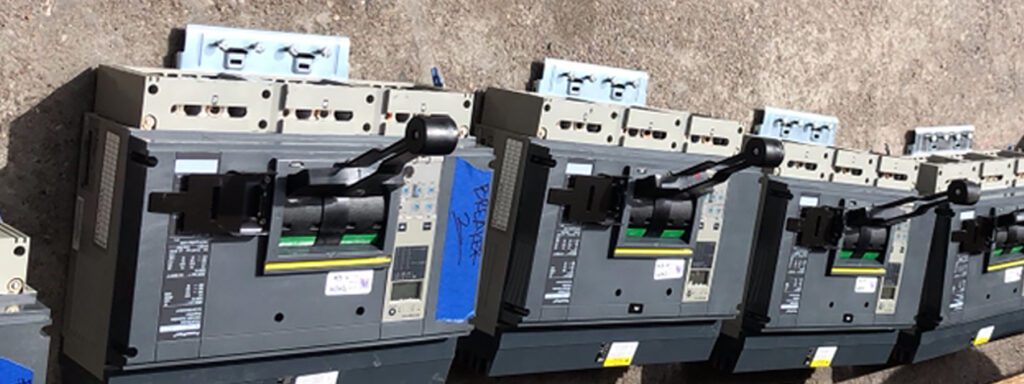
Here's the counterintuitive economics of our business: the breaker nobody makes anymore is often worth more than the one still in the catalog. Not despite being discontinued — because of it.
The installed base doesn't retire on schedule
A panel installed in 1972 was designed for a 40-year life and is now on year 54, still feeding a building that can't afford to replace it. When a breaker in that panel fails, the owner needs an exact-fit replacement — same frame, same mounting, same bus stab. The manufacturer moved on decades ago. The only supply is surplus: gear pulled from demolitions and cleanouts, tested, and resold as service stock.
The hall of fame
Westinghouse DB-series air breakers — out of production for generations, still running in plants everywhere, and priced accordingly. Old ITE frames from mid-century construction. Federal Pacific NA/NC breakers — controversial panels, but millions still installed, and owners who need a replacement pay scarcity prices while they plan upgrades. Zinsco, Pushmatic, early GE lines: same story, smaller scale.
- Westinghouse DB: the classic — never scrap one unquoted
- ITE/Gould frames: strong steady demand
- Federal Pacific: odd market, real prices
- Any breaker for a panel still widely installed
The math behind scarcity pricing
Obsolete breaker pricing follows a simple dynamic. Demand is fixed by the installed base: every building still running that panel needs replacements eventually, and that number changes slowly. Supply only shrinks — nothing new is produced, and every unit scrapped is permanently gone.
Fixed demand against a steadily shrinking supply means prices climb over time rather than depreciating. That is the opposite of how nearly every other used good behaves, and it is why the oldest item in a lot is frequently the most valuable one.
- No new production — used is the only source
- Installed base changes slowly, so demand persists
- Every unit scrapped makes the rest scarcer
- Code compliance requires a matching replacement
- Prices tend to rise rather than depreciate
Which obsolete lines to look for
The names worth pulling out of any lot: Federal Pacific and Federal Pioneer, Zinsco and Sylvania-Zinsco, vintage Westinghouse including the DS and DB series, older ITE and Gould, GE's AK and AKR air breakers, and early Square D I-Line frames that predate the current catalog.
Beyond the brand, the tell is often physical. Heavy steel construction, drawout mechanisms, cloth or asbestos-era wiring nearby, and hand-stamped or riveted nameplates all point to a vintage where new production stopped decades ago.
The practical rule for anyone clearing a building: if it looks too old to be worth anything, that is exactly when to photograph it before it goes in the container.
What this means for your shelf
That box of old takeouts in the back of the shop — the ones that look like nothing — deserves five minutes of nameplate photos before any cleanup run to the scale. We've paid four figures for shelves the owner had mentally written off. Text the photos to (951) 903-9804; the old stuff is frequently the headline of the quote.