
How We Price Your Equipment
No mystery, no games. Every offer we make comes from the same four questions, answered by your photos. Here's exactly what we look at, so you know what you're selling before you sell it.
And the part that matters most: the number we quote is the number we pay. If your photos were accurate, nobody re-trades you at the dock. That's been the rule here for fifteen years.
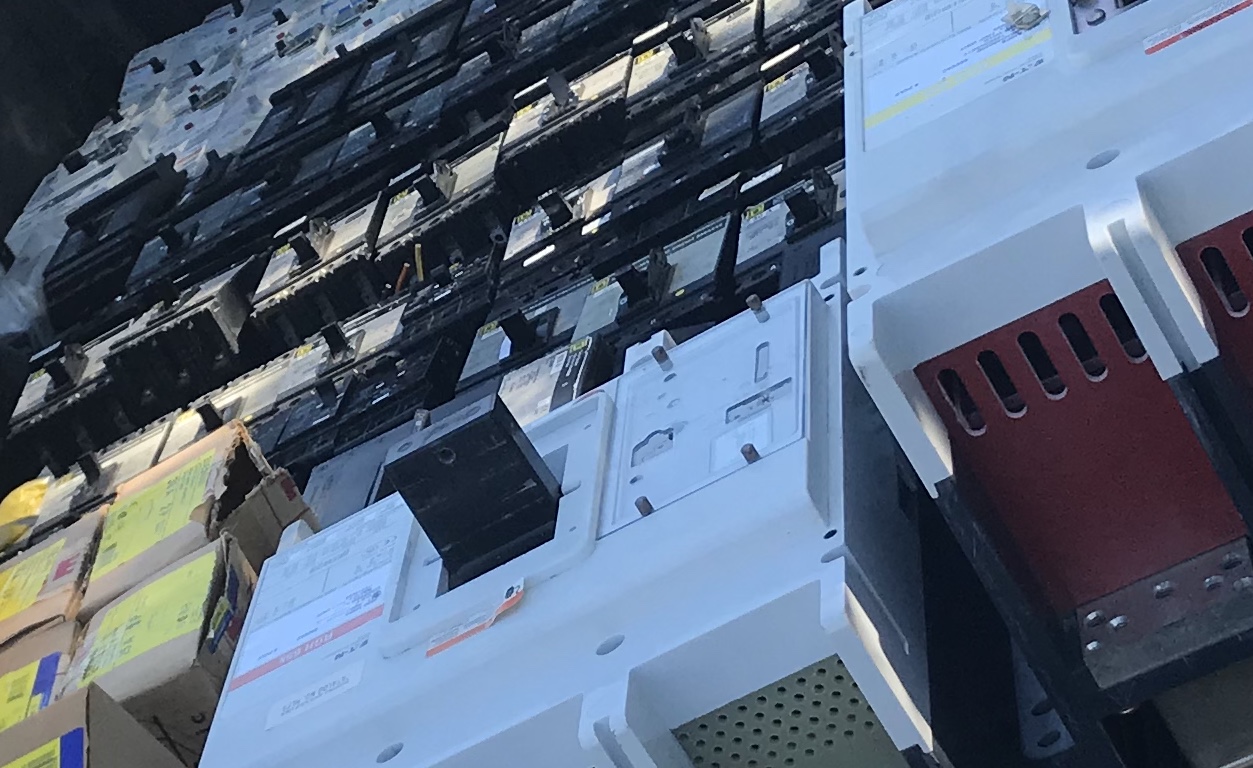
The four things that set every price
Frame size, kVA, amperage, catalog number. A 3,000-amp drawout breaker and a 20-amp plug-in are different worlds. The nameplate or label photo answers this in one shot — which is why we always ask for it first.
Square D, Eaton/Cutler-Hammer, GE, Siemens, ABB, Westinghouse, Allen-Bradley — strong demand, strong prices. Obsolete lines often pay MORE than current ones because someone's forty-year-old panel needs exactly that part.
New in box tops every range. Clean used sells steadily. Normal service wear barely moves the number. Fire, flood, or cracked cases move it a lot — and we'll tell you which is which for free.
Demand moves weekly. When a data center needs two hundred of one frame, that frame jumps for months. We watch the market every day, which is why a photo quote beats any static price list.
Why we quote from photos, not price lists
Websites with static price lists are guessing — surplus prices move with demand, and a list written in January is wrong by March. A photo of the label tells us the exact frame, vintage, and condition, and we price it against what buyers are paying this week. That's how we can commit to a number and honor it.
It also protects you. "A big GE breaker" could be forty different frames with a 50x price spread. The photo means you get paid for what you actually have — which is often more than you expected, especially with obsolete gear.
What a quote looks like
For valuable items you get a per-piece number: "the 1,200-amp frames are $X each." For mixed lots you get a lot price with the reasoning: "the pallet of molded case is $X, the two air breakers carry most of it." Either way you'll know what's driving the number — ask us anything about it, we like talking shop.
Quotes usually come back within the hour during the day. Text photos to (951) 903-9804 or email sellelectricalequipment@gmail.com.
What raises an offer, and what lowers it
Most of what moves a number is inside the seller's control, which is why it is worth spelling out. Completeness is the biggest lever: a breaker with its trip unit and rating plug, a bucket with its starter and overload, a panel with its interior and cover — each of those is a finished product to the next owner instead of a part hunt.
Sorting is the second. Forty like breakers on a labeled pallet price better than the same forty in a drum, because sorted material can be priced precisely while mixed material has to be priced conservatively against what we cannot verify. Photo quality is the third — a legible nameplate turns a range into a firm number.
- Trip units, plugs, and hardware still attached
- Panels, buckets, and lineups left intact
- Sorted and palletized by type and rating
- Legible nameplate and label photos
- Quantity of like items in one lot
- Obsolete and discontinued lines identified separately
- Breakers pried out of panels and damaged
- Missing trip units or unreadable labels
- Fire, flood, or heat damage
- Cut bus or torched switchgear sections
- Loose material in drums with no counts
- Difficult access with no photos of the route out
Where freight and rigging fit into the number
Our offers are net to you. Freight, rigging, fluid containment, and heavy haul are costs we carry and account for before quoting, not deductions that appear at the dock. That is why access matters to the price: a padmount at grade with truck access next to it and the same unit in a basement vault are different jobs, and the offer reflects it honestly up front rather than being revised later.
It also explains why quantity helps. A dedicated truck to a single small item rarely makes sense, while the same trip for a full pallet or a lineup does. If your lot is small, combining it with other equipment or shipping to us is usually the better economics, and we will say which applies to your situation.
Why we will sometimes tell you not to sell
Not every lot should be sold to us. Damaged units, tangled cut-off wire, and very small quantities of commodity items are frequently worth more to a scrapyard once freight is counted, and we would rather say so than talk you into a transaction that does not help you. The same goes for equipment where a deadline makes coordination impractical.
The reason that matters commercially is simple: this business runs on people calling back. A seller who got a straight answer once — including a "this is only scrap" answer — is the seller who sends photos the next time a real lot comes out of a building.
Want your number?
Text photos of the labels and nameplates. A real person prices them — usually within the hour.