
Sell Your Panelboards
Every tenant improvement and building re-power in America tears out panelboards, and nearly all of them land in a dumpster. That's money in the dumpster. A loaded 42-circuit panel with its breakers is a real check, and even bare interiors carry value in bus and mains.
We make it stupid simple: photo of the panel with the door open, photo of the label, text both to (951) 903-9804.
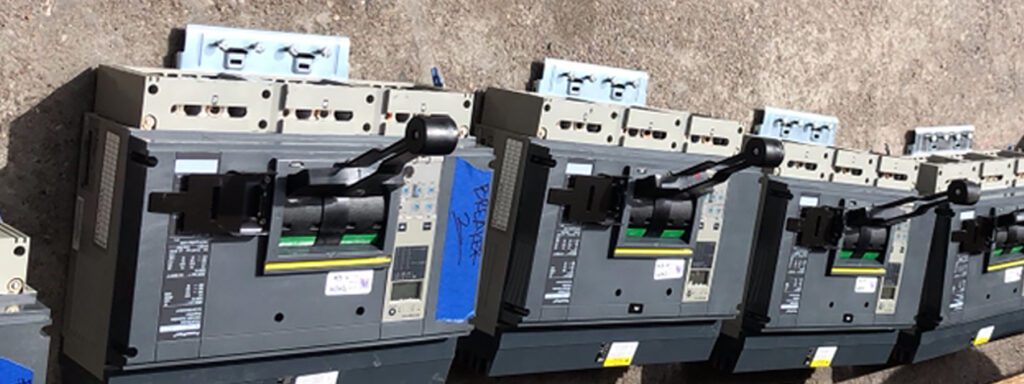
Loaded panels are worth the most
The breakers inside a panel are usually worth more than the panel itself, which is why we always want panels 'loaded' — breakers left in place. A typical NQOD or NF panel full of bolt-on breakers, with its main, is a meaningful payout. Multiply that by a floor of electrical rooms in a remodel and it adds up fast.
Square D NQ/NQOD and I-Line, GE A-Series, Eaton PRL1–PRL4, Siemens P1–P5 — the standard commercial families are all steady sellers for us. I-Line panels especially: those bolt-in FA/KA/LA breakers are perpetual best-sellers.
- Loaded lighting and distribution panelboards
- I-Line and power distribution panels
- Panel interiors — bus, mains, and breakers without the can
- Main breaker and main lug units, single or 3-phase
- Column-width and narrow panels from tenant spaces
A note for electricians on the job
If you're the crew pulling panels on a Friday demo: leave the breakers in, keep the deadfront and door with the can, and stand it on a pallet instead of tossing it in the roll-off. Five minutes of care turns dumpster weight into beer money — or a lot more, if the building had I-Line or medium-size distribution panels.
We buy from job sites constantly, and we can time our pickup to your demo schedule. One text with photos from the site, and the pallet's sold before the dumpster arrives.
What determines the price
Bus amperage and material (copper bus beats aluminum), breaker count and type (bolt-on beats plug-in), main breaker size, and condition. NEMA 3R outdoor cans add a little. Age matters less than completeness — a full old panel beats a stripped new one every time.
What panelboards are worth
A loaded panelboard is usually worth more than the sum of a stripped one plus loose breakers, which is the single most useful thing to know before a demolition crew touches it. The breakers inside are the value; the can, interior, and cover are what make them easy for the next buyer to use.
Amperage, voltage, and phase set the market. Standard 208V and 480V three-phase panels in common sizes move steadily. Where the value jumps is obsolete interiors: panels whose breakers are no longer manufactured serve buildings that have no other option, and those interiors can be worth multiples of what the steel suggests.
| Loaded panels, current lines | Steady demand; sell intact |
|---|---|
| Loaded panels, obsolete interiors | Often the highest value in a lot |
| Empty cans, interiors, covers | Modest; sold as parts |
| Distribution panels, 400–1,200A | Strong individual value |
| Loadcenters (residential style) | Volume category |
| Bolt-on vs plug-in interiors | Both sell; note which you have |
Selling panels out of a demolition or renovation
Photograph the panel schedule or directory card if it is there, the interior with the cover off, and the breaker labels. Those three shots usually answer everything we need to price a panel.
Leave it assembled. Prying breakers out damages them and turns a clean sale into a bin of chipped parts. If the panel is coming out of a wall, we would rather receive it whole with the interior intact, and our crew can do that removal on larger jobs.
Renovation and demolition timelines are the usual constraint. Send photos while the panels are still on the wall rather than after they are in a container, and we will work to your schedule.
- Photograph the interior with the cover off
- Capture breaker labels and the directory card
- Leave panels loaded and assembled
- Note amperage, voltage, and phase from the nameplate
- Send photos before demolition, not after
Before you scrap anything, send one photo
Scrap is priced by weight. Used electrical equipment is priced by what the next facility needs, and those two numbers are rarely close. A scrapyard has no reason to tell you that the item in your hand keeps a plant running somewhere.
There is no cost to finding out. Text photos to (951) 903-9804 — labels and nameplates if you can get them, wide shots if you cannot — and you will have a real number, usually the same day. If the honest answer is that your lot is only worth scrap, we will tell you that too, and you have lost nothing but a text message.
Common questions
Should I remove the breakers before selling a panel?
No — leave them in. Loaded panels are worth more, and pulling breakers risks damaging the stabs and bus that carry the value.
Do you buy residential loadcenters?
In quantity, yes. A single house panel isn't worth freight, but a contractor's pallet of loadcenters with breakers absolutely is.
What about panels with rusty cans?
The value is in the interior — bus, main, breakers. A rough can with a clean interior still gets a real quote.
Can you pick up from an active job site?
Yes, we do it all the time. Give us the site address and your superintendent's cell, and we'll coordinate around your schedule.
Should I pull the breakers before selling the panel?
No. Loaded panels are worth more intact, and removal damage lowers the value of the breakers. If they are already out, keep the trip units and hardware together with them.
What about very old panels with obsolete breakers?
Those are often the best items on a job. Discontinued interiors are the only option for buildings still running that equipment, so photograph them before anything gets demolished.
Related pages
Ready to sell? Call or text (951) 903-9804 or email photos to sellelectricalequipment@gmail.com.
Got equipment to sell?
Call or text us photos. We'll give you a price and take it from there.