
Circuit Breaker Buyers in Washington
Tech-driven re-powers and aerospace retirements make Washington a quality-over-quantity breaker state — exactly the gear worth real money.
We're a second-generation family buyer — 20+ years buying surplus circuit breakers nationwide from our Corona, California yard. Washington sellers deal directly with the person writing the check: text photos to (951) 903-9804 and you'll usually have a number the same day.
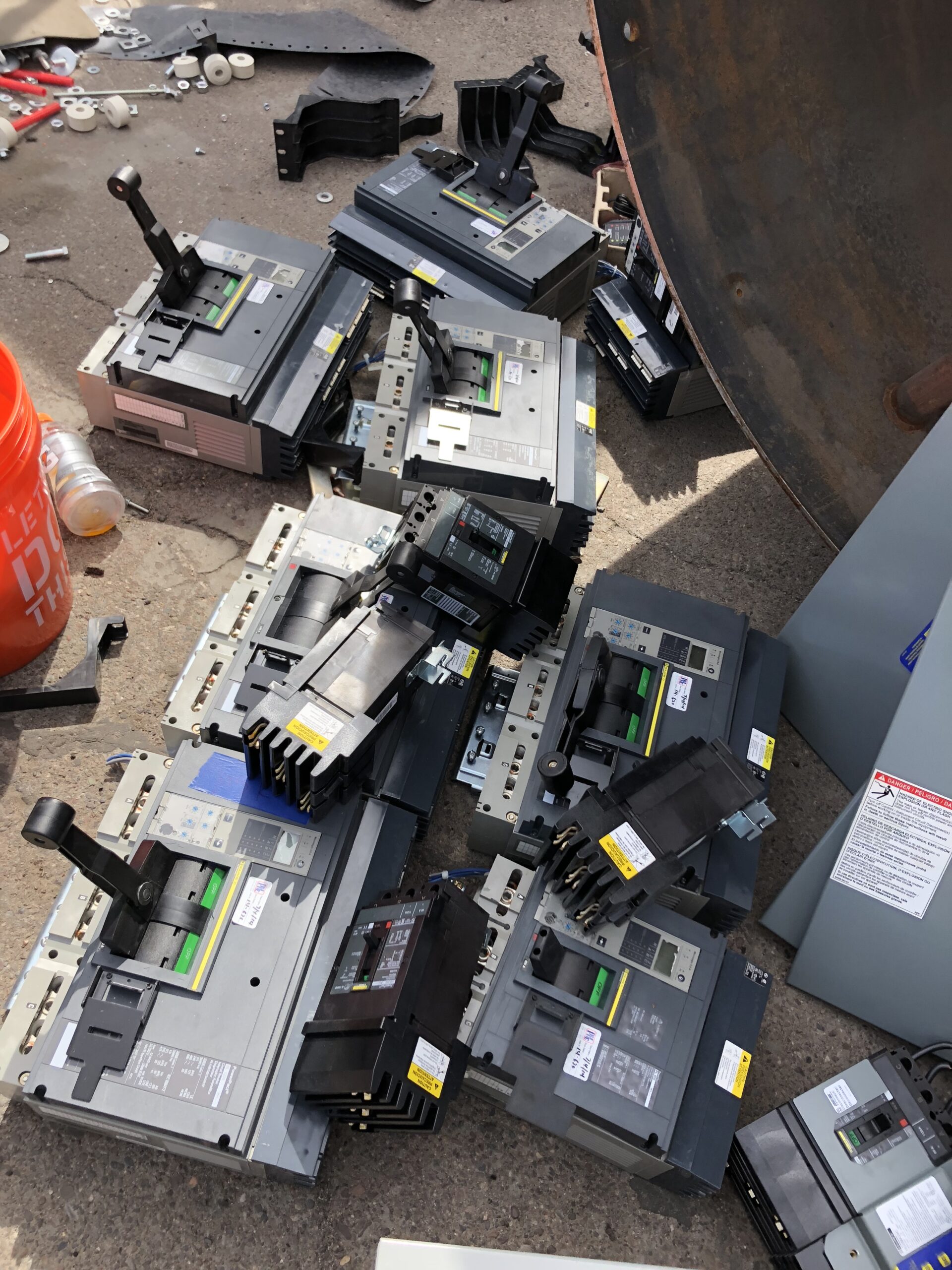
Where Washington's circuit breakers come from
Data center refreshes east of the Cascades produce late-model power breaker lots; Seattle TI work sheds loaded panels weekly; aerospace plant floors retire specialty and high-interrupting-capacity breakers that most scrapyards misprice badly.
- Breaker pickups in and around Seattle
- Breaker pickups in and around Tacoma
- Breaker pickups in and around Spokane
- Breaker pickups in and around Everett
- Breaker pickups in and around Vancouver
What we buy in Washington
Molded case and insulated case breakers, LV power breakers, MV air and vacuum breakers, loaded panelboards, MCC buckets, and new-in-box overage. Current brands like Square D, Eaton, GE, and Siemens — plus obsolete lines like Federal Pacific, Zinsco, and old Westinghouse that carry surprising replacement demand.
A breaker's value is its replacement demand, not its weight. Obsolete lines that keep old buildings running often out-price new gear pound for pound.
Logistics and payment in Washington
Don't let a scrapyard weigh what a reseller should grade. Text the label photos — Northwest pickups consolidate on regular runs and pay at handoff.
The process never changes: photos first, a real number second, and payment in full at pickup — cash, check, or wire, your choice. No consignment, no 'we'll settle after resale,' no waiting.
What makes one breaker worth more than another
Two breakers can look identical and be worth wildly different money. What separates them is replacement demand: how many facilities are still running gear that needs that exact part, and how hard it is to get one new. That is why a dusty 1970s breaker can outprice a newer one that everybody stocks.
Concretely, we are reading the frame size and amperage, the manufacturer and line, whether the trip unit is present and intact, and the interrupting rating. Complete units with their trip units, plugs, and mounting hardware are worth meaningfully more than bare frames, because the next owner does not have to hunt for parts.
The other thing that moves value is quantity of like items. A single 100-amp molded case breaker is a small transaction. Forty of them, sorted and palletized, is a real one — and sorted lots consistently earn more than mixed piles because we can price them accurately instead of conservatively. Washington contractors who sort before photographing get better numbers.
| Molded case breakers | Volume category; best sold in sorted lots |
|---|---|
| Insulated case and LV power breakers | High individual value, especially complete |
| MV air and vacuum breakers | Strong industrial demand; we handle removal |
| Loaded panelboards and MCC buckets | Bought whole — do not strip them first |
| New-in-box overage | Near-wholesale pricing |
| Obsolete lines (FPE, Zinsco, old Westinghouse) | Often the most valuable items in a lot |
Why obsolete breakers are frequently worth the most
This is the single most expensive misunderstanding in the business. When a line has been discontinued for decades, the buildings still running it cannot buy new — they can only buy used. Every one of those breakers that gets scrapped makes the remaining ones scarcer, and scarcity is exactly what drives price.
So the old panel in the back of a Washington building that a demolition crew was about to throw in a container may be the most valuable thing on the job. Federal Pacific, Zinsco, vintage Westinghouse and ITE, early Square D lines — these come out of older buildings constantly and get scrapped constantly, which is why we ask people to photograph before they demo.
The corollary is that we would rather buy a loaded panel intact than a bin of loose breakers pulled out of one. Removal damage is real, and a breaker that got pried out with a screwdriver is worth less than one that was unbolted properly. If you are not sure, leave the panel whole and let us take it as-is.
- Discontinued lines have no new-production competition
- Buildings that still run them have no alternative but used
- Complete units with trip units and hardware price highest
- Loaded panels are worth more intact than stripped
- Photograph before demolition, not after
How to package and photograph a Washington breaker lot
Breakers are the easiest category to sell well, because preparation genuinely pays. Sort by manufacturer and amperage where you can, stack them on a pallet rather than loose in barrels, and shoot photos in daylight with the labels facing the camera. That is the whole trick.
For each distinct type, we need the label legible: manufacturer, catalog number, amperage, and voltage. A photo of one label plus a count is enough for identical units — you do not have to photograph forty identical breakers individually. For anything unusual or old, photograph it on its own.
Once we have that, pricing is fast. Palletized Washington lots ship on our account from Seattle, Tacoma, Spokane or anywhere else in the state, and for larger quantities or panel and MCC removals our crew handles the work on site.
Scrap value versus resale value on breakers
By weight, a breaker is not much metal. That is precisely why scrapping them is such a bad deal: a scrapyard pays you for a few pounds of copper and steel, while the same unit may be worth many times that as a working replacement part.
We have seen this pattern for two decades. The lots that lose sellers the most money are the ones that went into a scrap container because nobody wanted to spend ten minutes taking photos. There is no downside to asking first — if a lot really is only scrap, we will tell you that too.
If you are clearing a site in Washington on a deadline, tell us the deadline. We work around demolition schedules routinely, and it is far better for both of us to get the gear out properly than to have it hauled off for weight.
Common questions
How do I sell my circuit breakers in Washington?
Text photos of the equipment and nameplates/labels to (951) 903-9804, or use the quote form. Most Washington lots get a firm number the same day, and we handle all freight and rigging.
Do you cover all of Washington or just Seattle?
All of it. Seattle, Tacoma, Spokane, Everett see us most often, but our trucks reach every county — for larger lots, distance is never the issue.
How fast do I get paid?
At pickup. We verify the equipment on site and pay before it leaves your dock — cash, company check, or same-day wire.
Do you buy obsolete circuit breakers in Washington?
Yes, and they are often the highest-value items in a lot. Federal Pacific, Zinsco, vintage Westinghouse and ITE, and early Square D lines all have active replacement demand because the buildings running them cannot buy new. Photograph them before anything gets demolished.
How many breakers do I need to have before it is worth selling?
A single large power breaker or an unusual obsolete unit can be worth selling on its own. For standard molded case breakers, a pallet-sized lot is where it gets efficient. Send photos either way and we will tell you honestly where yours lands.
Should I pull the breakers out of the panel first?
Generally no. We would rather buy loaded panelboards and MCC buckets intact, because removal damage lowers value and we already have the tools and process for it. If they are already out, that is fine too — just keep the trip units and hardware with them.
What paperwork do you need for a Washington purchase?
For most sales, very little — an invoice or bill of sale and payment details. Facilities and institutions that need their own purchase documentation, insurance certificates, or vendor onboarding get whatever their process requires; we deal with plant, hospital, and municipal purchasing regularly.
Related pages
Ready to sell? Call or text (951) 903-9804 or email photos to sellelectricalequipment@gmail.com.
Got equipment to sell?
Call or text us photos. We'll give you a price and take it from there.